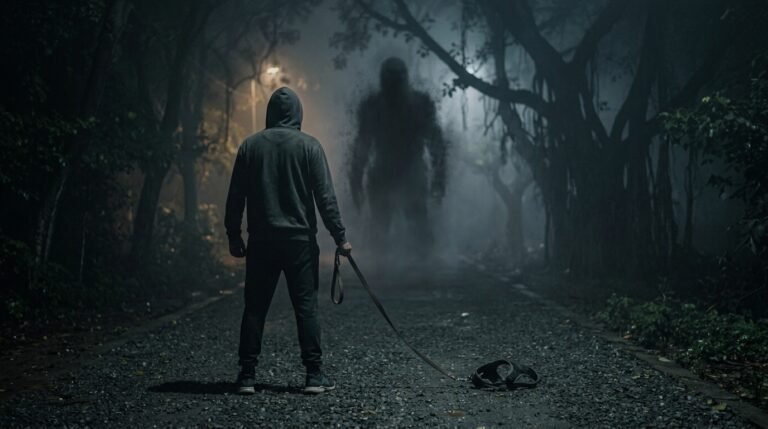

Deep within the suffocating, frozen expanse of the New England wilderness, a solitary cabin sat choked by centuries-old pines. Their gnarled branches clawed at the gray winter sky, sealing the property in a claustrophobic tomb of timber and frost.
Ethan was a man consumed by the archaic. His fascination with forgotten antiquities and historical enigmas wasn’t just a career; it was a slow-burning madness that eroded everything else in his life. So, when an eccentric, frail woman in Boston handed him a leather-bound journal rumored to belong to a 17th-century hermit who had perished in the colonial wilderness, Ethan didn’t hesitate. He rented the isolated cabin, eager to bury himself in research, entirely cut off from the modern world.
The journal itself was an unsettling artifact. Its binding was made of scarred, burnt leather that smelled faintly of copper and ash. There was no author’s name, only a crude, unsettling emblem seared into the cover: a silhouette of a figure with impossibly long, disjointed limbs.
The first two days yielded nothing but bitter cold and silence. Ethan spent the endless, freezing nights huddled near a small wood-burning stove, the rhythmic scraping of ancient pages turning the only sound in the room.
But on the third night, the atmosphere shifted.
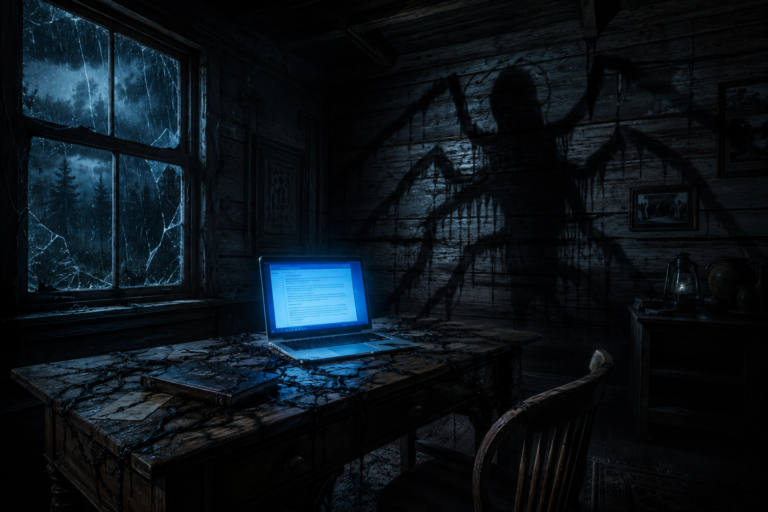
A violent, unnatural blizzard slammed into the mountain, unleashing howling winds that violently whipped the pines, making the timber groan like breaking bones. Ethan sat at his heavy oak desk, a single kerosene lamp casting long, erratic shadows across the cabin walls. He was staring at page twenty when the text began to warp. The faded, centuries-old script suddenly bled, thickening into wet, pitch-black ink that shimmered under the firelight as if freshly written.
The passage read:
“They do not dwell behind the trees; they dwell within them. When the wind howls, it is their breath scraping against your ears. I have seen them. Their eyes are the color of rotting sulfur, and they watch anyone who dares to think of them.”
Ethan let out a shaky breath, removing his glasses to rub his strained eyes. He forced himself to believe it was just fatigue, a trick of the flickering lamplight.
Then came the sound from the kitchen counter.
It was a low, wet friction—the unmistakable sound of something heavy and saturated being dragged slowly across the floorboards. Drag. Pause. Drag.
Holding the kerosene lamp high, Ethan stepped into the dark. The weak amber glow pushed back the shadows only a few feet at a time. When he reached the counter, there was nothing. No intruder. Only a tiny, rhythmic splash.
Drip. Drip.
A puddle was forming on the floor. Ethan looked up, expecting a leak, but the ceiling was bone dry. He knelt down, plunging his finger into the liquid. It wasn’t water. It was a thick, viscous black ink, identical to the fluid seeping through the pages of the journal.
His heart hammered against his ribs like a trapped bird. Terrified, he spun around to retreat to his desk, but his breath caught in his throat.
Pressed flat against the frosted window pane was a hand.
It wasn’t human. The fingers were elongated, stretching nearly the length of the entire glass pane, completely devoid of skin. It was just raw, glistening black flesh, twitching rhythmically against the glass.
The storm outside escalated into a deafening roar, the wind mimicking the synchronized screams of a thousand dying voices. Ethan lunged for the journal, desperate to slam it shut, but his hands froze an inch above the paper. A heavy, suffocating pressure invaded his mind, an external force tearing through his consciousness, commanding him to look down.
The next page flipped itself over with a crisp, violent snap. New words materialized before his eyes:
“Ethan, you have unlatched the door. You are part of the chronicle now.”
Ethan’s chest heaved. His own name was drying on the centuries-old parchment in that horrific, wet ink.
Panic overtook him. Throwing his winter coat over his shoulders, he bolted for the heavy front door. He grabbed the iron handle and threw his entire weight into it, but the mechanism didn’t budge. With a sickening crack, the iron handle snapped off entirely in his hand.
Simultaneously, the flame in the kerosene lamp died. Total darkness swallowed the cabin, lasting only a second before the monitor of his laptop on the kitchen counter erupted to life. It cast a harsh, ghostly blue glow over the room.
In that sterile light, Ethan saw it.
Standing in the corner of the room was a towering silhouette. Its distorted torso stretched all the way to the ceiling, its unnaturally long limbs bent at sickening angles. It had no face, no features—save for two wide, glowing, sulfur-yellow eyes that bored straight into his soul.
Ethan tried to scream, but the air in his lungs turned to ice; his vocal cords produced nothing but a dry gasp.
The entity moved. With every agonizingly slow step it took toward him, the floorboards shuddered as if an earthquake were tearing through the foundation. On the kitchen counter, the laptop keys began to clack violently on their own, the sound sharp and sterile in the freezing room.
Text typed itself rapidly across the screen:
“There is no escape. To perceive them is to invite them to hollow you out.”
A sharp, stinging agony flared in Ethan’s hands. He looked down and watched in horror as pitch-black ink began to seep out from beneath his fingernails, reversing its flow, burrowing deep into his veins. The black veins crawled up his wrists, freezing his blood. His limbs grew stiff, heavy, and numb. He was hardening into a monument of ice and wood, mirroring the fate of the hermit who had come before him.
The entity now stood directly over him, casting a shadow that blotted out the blue light. It raised a long, skinless hand and pressed a single, freezing finger against Ethan’s forehead.
The touch was absolute zero—a cosmic cold that didn’t just freeze the flesh, but utterly extinguished the soul.
Ethan’s eyes were forced wide open, the muscles locking into place. His mind was flooded with a barrage of horrific, fragmented visions: centuries of lost travelers wandering into these woods, their skin peeling, their bodies being absorbed into the bark of the trees, their eternal screams echoing in his mind. This wasn’t a mere ghost or a local haunting. This was an ancient, cosmic malice native to the primordial earth—a force that fed exclusively on the morbidly curious.
The next morning, the blizzard broke. Weak, pale sunlight filtered through the dense New England canopy, painting the cabin in a deceptive warmth.
Inside, the air was dead silent. The window glass was intact. The kitchen counter was spotless. The laptop sat completely powered down and cold to the touch.
On the heavy oak desk, the ancient journal lay open to its final page. At the very bottom, beneath the freshly dried name of Ethan, was a single imprint of a hand, rendered in thick, black ink.
But the cabin was empty.
Out in the frozen woods, the wind picked up again, rustling through the pines with a sound that held just a hint of a human cry, waiting patiently for the next collector to come looking for secrets.
In the damp, subterranean vaults of the Boston Antiquarian Society, the air carried the permanent, cloying stench of rotting pulp and forgotten mold. Marcus remained hunched over his desk, isolated beneath the street-level thrum of the city.
It had been precisely one week since Ethan’s sudden disappearance into the New England wilderness. After a cursory sweep of the isolated cabin, local authorities had stamped the case file closed, chalking it up to a routine missing persons report—the tragic consequence of a city boy getting lost in winter. But Marcus knew better. Ethan wasn’t the type of man to abandon his lifework on a whim.
Marcus’s eyes remained locked on a specific crime scene photograph leaked by a contact on the force: a high-resolution shot of Ethan’s heavy oak desk, its center scarred by a wet, glistening handprint of pure, pitch-black ink.
With a ragged sigh, Marcus turned back to the contraband documents he had smuggled out of the museum’s restricted colonial archive. These were the suppressed municipal records of the first Puritan families who had dared to settle the uncharted interior of Maine in the mid-1600s. As his fingers traced the brittle, jaundiced parchment, a cold sweat broke across his forehead.
There were no accounts of smallpox, famine, or indigenous warfare in these journals. Instead, the final entries of every prominent lineage concluded with the exact same chilling postscript:
“When the night deepens, the pulse rises from beneath the frost. It beats in sequence with our own tissue, until our hearts no longer belong to us.”
A sharp scuffle echoed from the dark labyrinth of bookcases behind him.
Marcus spun around, his heart leaping into his throat. The weak amber beam of his desk lamp illuminated only the towering, dust-choked rows of historical volumes. Nothing moved. Then, with a violent, metallic pop, the overhead fluorescent tube flickered wildly and died, leaving behind a high-pitched, agonizing hum before plunging the vault into near-total darkness.
Now, the only illumination was the sterile, ghostly blue glare of his desktop computer, throwing long, skeletal shadows against the concrete walls.
A sudden prickling sensation flared in his right hand. It felt as though hundreds of microscopic needles were methodically burrowing beneath his skin. Holding his palm up to the monitor’s blue light, the breath died in his throat.
The veins in his wrist weren’t blue or red. They were bulging with a thick, viscous black fluid that raced upward toward his forearm. It was the exact substance described in the margins of Ethan’s final research notes.
On the desk, the computer monitor began to warp. His open database files abruptly crashed, replaced by a single, stark white text document. The cursor throbbed violently in the center of the screen. Then, without a finger touching the keys, words began to materialize. The sound of the typing wasn’t the soft click of plastic keys—it was a heavy, deafening clatter, like iron rods smashing against stone.
The text typed itself out at a manic pace:
“Marcus. Did you truly believe you were merely an observer? To look upon the imprint is to invite the architect inside. He is hollowing out your memories now, using them to anchor his weight back into this world.”
Terrified, Marcus lunged forward and ripped the keyboard’s USB cable directly out of the port. The typing didn’t stop. The text tore across the screen, accelerating until the monitor itself began to bleed. A thick, ink-like black fluid oozed from the edges of the bezel, dripping heavily onto his paperwork.
He tried to throw himself back, but his office chair felt as though it had fused seamlessly with the concrete floor. The air in the vault grew dense, heavy with the stench of stagnant mud and organic decay.
Then came the voices.
It started as a low, synchronized chant—thousands of whispers reciting a funereal dirge in a harsh, guttural dialect that predated modern language. The sound wasn’t bouncing off the walls; it was vibrating directly inside the folds of his own brain.
Marcus looked up. Directly behind the bleeding monitor, two pale, sulfur-yellow eyes materialized out of the dark. They possessed no pupils, no human anatomy—just a flat, luminescent malice that stared entirely through his flesh. A towering, disjointed silhouette reached out, extending an impossibly long, skinless arm toward Marcus’s face. The stench of dead soil radiating from the entity was so overwhelming that Marcus instinctively clamped his eyes shut, bracing for the impact.
When he opened his eyes a few seconds later, the concrete walls of the Boston basement were gone.
He was standing knee-deep in snow, deep within the claustrophobic, frozen expanse of the Maine wilderness. Before him stood the crooked, decaying timber cabin from the photograph. Inside its frost-covered window, a weak, rhythmic blue light pulsed against the glass.
The gale-force winds tore at his clothes, but Marcus could no longer feel the cold. Looking down, he watched as the black fluid erupted from his boots, burrowing deep into the permafrost, hardening into thick, woody roots that anchored him permanently to the cursed earth.
Marcus clawed at the air, violently thrashing his upper body to break free, but the saturated permafrost held him with the crushing torque of an industrial magnet. The gale-force wind whipped dead, frozen leaves across his face. Each brittle edge that scraped his skin left a thin, burning laceration, as if the forest itself were flaying him alive. Ahead, the shifting blue light bleeding through the cabin window deepened into a toxic, bruised violet—pulsing like the exposed heart of the cosmic entity that kept this wilderness in a state of perpetual strangeness.
Then, with a deafening, splintering crack, the cabin’s heavy timber door exploded outward.
The violent amethyst light spilled across the snow, illuminating a tall silhouette that stepped methodically into the freezing air. Marcus’s chest locked; the coat, the frame, the uneven gait—it was unmistakably Ethan. But as the figure stepped fully into the light, a choked, silent scream died in Marcus’s throat. It was Ethan, but only in outline. His features had been violently hollowed out. Where his eyes should have been, there were only two jagged, bottomless craters weeping that familiar, iridescent black ink. His skin was the color of curdled milk, translucent and completely bloodless, like a corpse reanimated by an unnatural current.
Ethan extended an elongated, multi-jointed arm toward Marcus. When he spoke, the sound didn’t come from a throat; it was a discordant chorus of a thousand drowned voices vibrating through the air:
“Marcus… you chased the text, but the text has no ending. It is a closed loop. Everyone who observes the line becomes the ink. Now, you will carry the chronicle forward.”
With a desperate, animalistic surge of adrenaline, Marcus threw his entire weight backward, tearing his legs free from the mud with a sickening, suctioned pop. He didn’t look back. He bolted into the claustrophobic labyrinth of the woods, ducking as the low-hanging branches scraped down like skeletal fingers trying to hook into his clothes.
He ran blindly, his boots fracturing frozen roots and slamming into jagged stone. His lungs burned, turning the sub-zero air into sharp needles in his chest. Yet, no matter how hard he sprinted into the darkness, the geometry of the forest warped around him. He wasn’t escaping; he was running in a maddening, recursive loop. Every time he glanced over his shoulder, the crooked cabin and the hollowed shadow of Ethan remained at the exact same distance—as if the topography itself were shifting to keep him trapped in the entity’s epicenter.
Suddenly, his boot caught a thick, frozen root. Marcus slammed face-first into the freezing, wet earth, the impact knocking the remaining air from his lungs.
Gasping, he pushed himself up with his palms, only to realize his left arm was completely unresponsive. He looked down. The black, bulging veins had crawled past his shoulder, completely deadening his tissue. His arm felt like a heavy, frozen log attached to his torso.
Shaking violently, he raised his head to survey the treeline—but the trees were gone.
He was flat on his stomach on the cold, concrete floor of the Boston Antiquarian Society, huddled beneath his own desk. The desktop monitor above him was still active, casting that same sterile, aggressive blue light against the concrete wall.
Then came the sound. From directly above him, on the desktop, came the faint, rhythmic scraping of a chair shifting.
Marcus held his breath, his eyes widening in the darkness beneath the desk. Someone—something—was now sitting in his chair. The back of the entity was turned toward him, but Marcus could see its impossibly long, skinless fingers hovering over the keys.
Clack. Clack. Clack.
The sound of the typing was deafeningly loud in the enclosed vault, striking like iron bars against stone. With every stroke, thick streaks of wet black ink splattered against the plastic chassis of the keyboard. Slowly, with a sickening, wet clicking sound of vertebrae popping one by one, the entity began to rotate its head a full one hundred and eighty degrees toward the floor.
Marcus stared up, paralyzed, knowing that the moment those sulfur-yellow eyes locked onto his, the final sentence of his life would be written.
The head didn’t rotate with the smooth motion of living muscle; it turned with a succession of wet, splintering cracks as the cervical vertebrae shattered and rearranged themselves, forcing the skull through a violent, impossible one-hundred-and-eighty-degree arc.
When the face finally locked into position, staring straight down into the shadow of the desk, Marcus’s remaining sanity fractured.
The entity sitting in the chair was himself.
It was a grotesque, funhouse-mirror distortion of his own features. The skin was drawn tight across the bone, grey and completely sapless. Its eyes were milky, blind spheres rolled back into the skull, and from its slack jaw, a continuous, heavy stream of the iridescent black fluid spilled directly onto the clattering keys.
The double looked down at Marcus, its mouth twisting into a rigid, hollow grin. Simultaneously, Marcus’s own voice echoed within the vault of his own mind, loud and mocking:
“The chronicle requires a fresh hand to reach its denouement, Marcus. You are no longer the scholar analyzing the ink. You are the instrument that spills it.”
In that exact microsecond, the sterile blue glare of the monitor exploded into a blinding, incandescent flash that completely swallowed the subterranean archive. Marcus instinctively tried to throw his hands over his face, but the paralysis was absolute. His tissue hardened like calcified timber, anchoring him beneath the desk. His eyelids were forcibly peeled back, veins screaming in agony as the searing amethyst light burned through his retinas.
Beneath the desk, his physical body began to lose its cohesion, melting away like thawed ice. His consciousness, his memories, and the very core of his identity were violently siphoned upward, dragged through the air and compressed into the missing cavities of the entity sitting in the chair.
When the blinding glare finally receded, a profound, suffocating silence descended upon the vault.
The space beneath the heavy desk was completely empty. No clothes, no residue—just a faint scent of copper and old soil.
The figure in the chair stirred. It rose methodically, its joints clicking into place as it stood under the weak light. It raised its elongated, multi-jointed hands, tracing the thick, black tracks of dead veins that patterned its skin, and exhaled a ragged, ancient breath. Inside this vessel, Marcus’s intellect, Ethan’s raw terror, and the primordial, cosmic hunger of the wilderness had fused into a single, cohesive consciousness.
The entity reached down and picked up Marcus’s smartphone from the desk—a device that had been dead for hours.
The screen instantly flickered to life under its touch, bypassing the lock screen and the operating system entirely. It didn’t display a menu or an application grid. Instead, it opened directly onto a global digital forum, where a newly compiled text document sat staged and ready for transmission.
The manuscript bore the exact title Ethan had uncovered in the frozen heart of the Maine woods.
The entity hovered its long, ink-stained index finger over the glowing ‘Post’ button. The tip of its skinless finger left a damp, dark smudge on the glass.
It pressed down.
With that single keystroke, the narrative was unleashed into the digital ether, weaponized and surging across fiber-optic cables to millions of illuminated screens across the globe.
This was no longer a localized infection confined to the New England timber or the damp vaults of a Boston archive. It was a cosmic web, broadcasted directly into the modern world, ready to tap against the glass of a million unsuspecting minds.
And every single reader who opened the text, scrolling through the lines out of morbid curiosity, had just taken their very first step toward the wood.
Thousands of miles away from that cold, subterranean vault in Boston, the quiet suburbs of Chicago lay wrapped in a thick, midnight stillness. In the dead center of her pitch-black bedroom, Claire sat propped against her headboard. It was 1:00 AM. The only source of light was the aggressive, sterile glare of her smartphone screen, washing her face in an eerie, synthetic pallor. She was aimlessly scrolling through her social media feed, looking for anything to dull her insomnia, when her thumb abruptly froze.
A new post had just populated at the very top of her timeline. The title was jarring, radiating a strange, magnetic pull that instantly commanded her attention:
“The Cosmic Obsession: Scary Stories to Tell in the Dark.”
Claire was a connoisseur of the macabre; psychological thrillers and visceral horror literature were her drug of choice. Assuming this was just another piece of well-crafted creepypasta or a viral marketing campaign, she didn’t hesitate. She tapped the ‘Read More’ link.
The moment the first paragraph rendered on her screen, the ambient temperature in her bedroom plummeted. A sudden, unnatural draft cut through the room, so bitter that her breath hitched. Shrugging it off as a malfunction in the central heating system, she pulled her heavy duvet tighter around her shoulders and kept reading.
She became utterly hopelessly entangled in the cadence of the text. Time lost its meaning. With every sentence she consumed, her heart hammered faster against her ribs, yet an invisible, suffocating weight anchored her gaze to the glass. She was entirely paralyzed by the narrative. The story detailed an isolated cabin, a lost hermit, and a museum archivist whose very identity had been systematically hollowed out by a parasitic, pitch-black ink.
As her eyes raced across the glowing paragraphs, Claire felt a sharp, prickling numbness in the fingers of her left hand—the hand holding the phone.
Under the harsh glare of the display, she saw it. A thin, branching black line had materialized just beneath the surface of her skin, tracing the path of her radial artery. It looked as though a thick, viscous black fluid was methodically crawling up her wrist. Panic surging through her chest, she aggressively rubbed her eyes, forcing herself to believe it was a visual hallucination—just eyestrain caused by the blue light and sleep deprivation.
But then, she reached the final sentence of the post.
The exact moment her eyes registered the last period of the text, the smartphone’s display flickered violently and died. The phone became completely unresponsive, a cold slab of glass and aluminum. Total, impenetrable darkness swallowed the bedroom.
In the dead silence that followed, a sound materialized from directly beneath her mattress.
It was a low, ragged, wet exhalation. The sound possessed a sickening, fluid density, accompanied by an instant, overwhelming stench that filled the room—the foul odor of stagnant permafrost, rotting timber, and organic death.
Claire’s entire nervous system locked. The paralysis was instantaneous and absolute; she couldn’t even draw enough air to scream.
Out of the blackness at the foot of her bed, two wide, unblinking, sulfur-yellow eyes rolled into view. They held no pupils, only a flat, ancient malice that stared straight through her flesh. The recursive loop had reached Illinois, and the cosmic madness was already weaving itself into the very fabric of her walls.
Claire tried to wrench her frozen limbs upward, to pull the heavy duvet over her face, but her musculature flatly refused to respond. The pitch-black dark of the bedroom felt as though it had pressurized, solidifying around her like concrete walls, pinning her to the mattress. And those sulfur-yellow eyes—they were rising. Slowly, methodically, they drifted from the foot of the bed, gliding upward through the dark. This was no localized spirit, no cliché haunting from a suburban legend; this was a primordial, cosmic horror that had traveled through the fiber-optic infrastructure of the modern world to claim her sanctuary.
Suddenly, her smartphone screen erupted back to life.
But the light wasn’t the sterile blue from before. The display emitted a deep, saturated crimson—a blood-red glare that stained the entire room. In that violent illumination, Claire watched in absolute terror as the plaster on her ceiling and walls began to blister and warp, twisting into the grain of ancient, rotting timber. Her bedroom was actively reforming into the structural layout of that desolate Maine cabin. Her closet, her clothes, her vanity desk—everything was decomposing, liquefying into pools of that iridescent black ink.
“There is no final page to the chronicle, Claire,” a low, cracking voice rasped against her ear.
The sound was bleeding directly from her phone’s internal speaker, yet the vibrations didn’t strike her eardrums; they resonated intimately within the core of her brain cells.
“This obsession is a recursive web. Every fresh mind that observes the script is pulled inevitably into the epicenter.”
Claire felt the physical mass of her body begin to evaporate. She was sinking, drowning in a subterranean sea of crimson light and viscous black ink. Her thoughts, her childhood memories, her peaceful life in the Chicago suburbs—everything was being dissolved, ground down to serve as raw fuel for this eternal malice. She was no longer Claire, the reader. She had been rewritten. She was now a fresh sentence, a new, glistening imprint destined to drift through the digital void, waiting for the next curious eye to click the link.
When the morning sun finally broke over the Chicago skyline, casting its light down her quiet suburban street, Claire’s bedroom sat in immaculate order. The sheets were neatly tucked, her vanity was untouched, and her phone remained plugged into its charger on the nightstand.
But on that screen, a new update had just automatically posted to her profile. The text was identical to the ancient, cosmic enigma that had survived the centuries.
The web had just cast itself out into the network once more, hunting for another consciousness to hollow out. For as long as someone keeps reading, the ink will never dry, and the dark will never end.
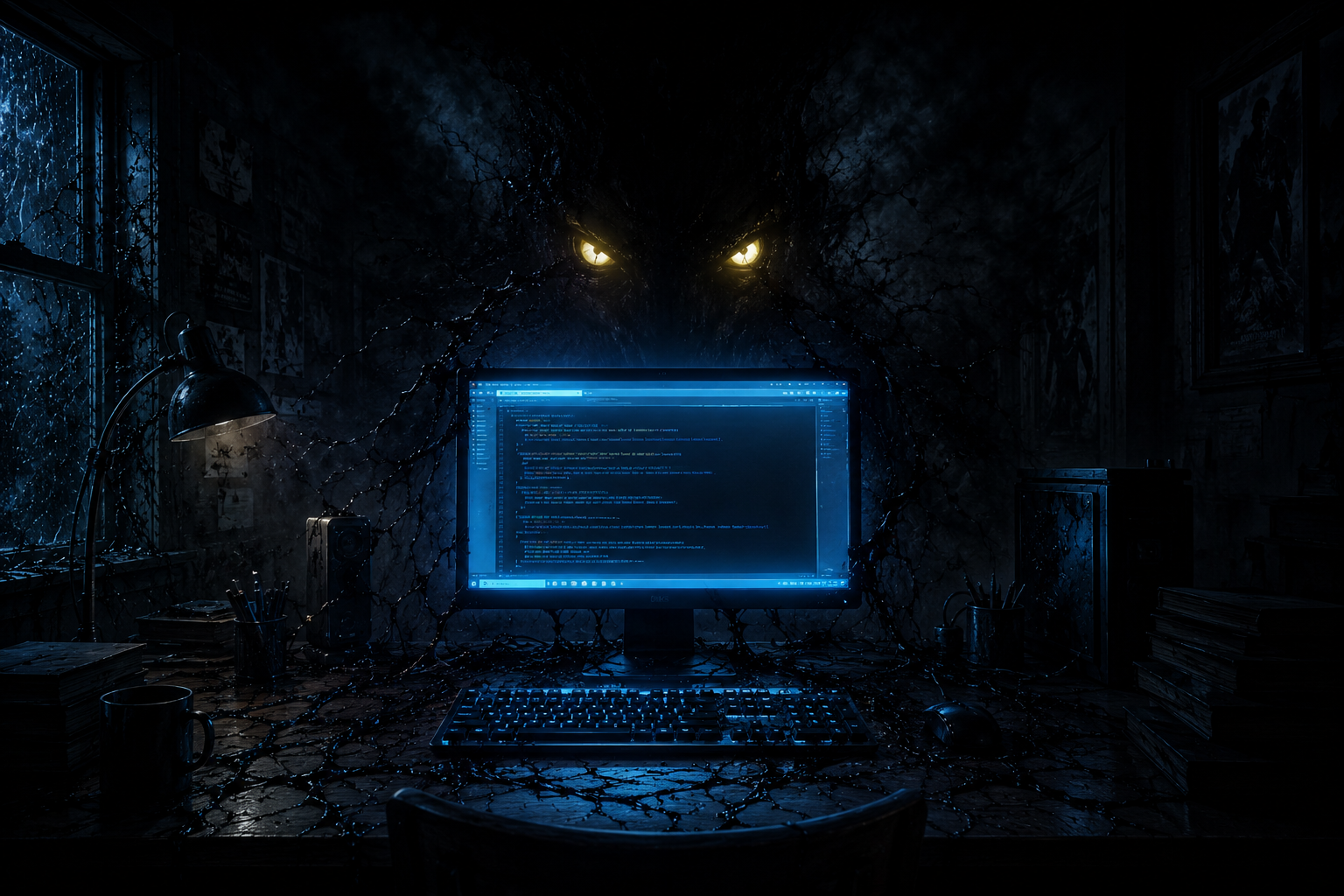
Years later, a new tenant moved into that quiet house on the desolate Chicago street. David was a freelance software engineer, a pragmatic man whose nocturnal routine consisted of writing code and hunting bugs until the pre-dawn hours. One night, while scouring the deeper, unindexed forums of the web for an open-source project repository, his system suddenly froze. The high-end monitor flickered, the screen blurring into a chaotic matrix of static before a primitive, blue-tinted word document forced itself into full screen.
At the top of the page, rendered in stark, aggressive block letters, gleamed the exact title that had already siphoned away countless minds. David smirked, leaning back in his ergonomic chair. He figured it was a sophisticated malware strain or a clever prank executed by a rival hacker. He grabbed his mouse to kill the process, but the cursor remained completely unresponsive, frozen in the dead center of the blue screen.
Then, from directly behind his monitor, out of the void of the freezing, stagnant bedroom, two pale, sulfur-yellow eyes rolled into the light. They held no pupils, no human anatomy—just a flat, luminescent malice that belonged to the eternal, cosmic obsession. The entity had officially established its next epicenter within the geography of this Chicago room.
David felt an immediate, piercing agony in his left hand. Under the glare of the monitor, he watched as a thick, viscous black fluid erupted through his veins, spreading rapidly up his forearm and locking his fingers rigidly onto the keyboard like calcified timber.
The keys began to actuate on their own, unleashing a rapid, deafening clatter that shook the desk—the sound of iron rods smashing against stone.
Clack. Clack. Clack.
This time, the script was rapidly typing David’s own name into the text, knitting his consciousness into the manuscript. With that final keystroke, the recursive loop sealed itself once more—a maddening geometry that possessed no true beginning and no denouement. The chronicle was now buried forever within the hollowed-out tissue of a new mind, its ancient, suffocating hex destined to endure until the very stars burned out.
Also Read: Obsession is Just the Beginning: Short Horror Stories of Cosmic Horror and Dark Entities